

TL;DR
The best time of year to replace a roof in Southwest Washington is summer, roughly July through September, when the region gets its most reliable stretch of dry weather and new shingles can seal the way they are designed to.
Fall still works if you move early, while spring and winter bring rain delays and slower sealing. If your roof came through the wet season looking worn, get it inspected now so the replacement can be scheduled before the rain returns.
Most homeowners think hard about their roof in January, when the rain is loud and there is not much anyone can do about it. By the time July arrives and the weather finally cooperates, the roof has gone quiet and slipped off the list. That gap is where small problems get expensive.
Timing a replacement here has less to do with the calendar on your wall and more to do with what the weather will actually let a crew do. This guide covers the best time of year to replace a roof in Southwest Washington one season at a time: what makes summer the easiest window, when fall still works, and what you give up by waiting.
It also covers what to look at before you book anything, since an inspection is what tells you whether you are facing a full replacement or a targeted repair. Alfred’s Roofing has been doing this work across the region for more than 30 years, long enough to know how a roof here behaves after a wet winter and how fast the dry months book up.
Why Summer Is the Best Time of Year to Replace a Roof in Southwest Washington
Good roofing weather is not something this region hands out generously. Summer is the one stretch that reliably delivers it, which is why most planned work here gets scheduled between the end of the wet season and the start of the next one.
More workable mornings, a clear view of whatever the crew uncovers once the old material comes off, and safer footing on the roof itself all come with dry conditions. Those are the practical reasons a roof replacement in Southwest Washington is easier to plan and finish well in summer than in any other season.
July through September are usually the driest months of the year in this part of Washington, and that dry stretch does more than keep the crew comfortable. Asphalt shingles arrive with a sealant strip applied along each course at the factory, and that strip does not bond the moment it is nailed down. Warmth activates it, usually from direct sun, and the bond is what pulls each shingle tight against the one beneath it.
In summer heat that can happen within a day or two of installation. In cool or damp conditions it takes considerably longer, and crews sometimes have to seal courses by hand to make up the difference. Underlayment also goes down without moisture trapped underneath it, which matters on a roof that just spent eight months wet.
The catch is that every other homeowner with an aging roof is looking at the same short list of weeks. Summer calendars fill up quickly, so reaching out now usually means a start date a few weeks out rather than the same week.
That is still solidly inside the dry window, and it is a very different position than calling after the first hard rain, when the choice narrows to three options and none of them are good: rush the job, delay it, or push a worn roof through another wet season.
When to Replace Your Roof in Washington, Season by Season
Summer being the easiest window does not mean the rest of the year is off limits. Roofs get replaced here in every season, and a good crew can do solid work in October or February.
What changes is how much of the schedule the weather controls, and how much room you have to plan. Here is how the four seasons compare for homeowners from Vancouver and Camas up through Longview and Chehalis.
| Season | Working Conditions | The Tradeoff |
|---|---|---|
| Summer (July to September) | The longest reliable dry stretch of the year, warm enough for shingles to seal within a day or two | Calendars fill early, so the start date depends on when you call |
| Fall (late September to October) | Often still dry and mild through mid-October, with good working temperatures | The window closes without much warning once the rain settles in |
| Spring (March to May) | Milder weather returning, but rain comes and goes without a pattern | Dry days arrive in short runs, so start dates shift with the forecast |
| Winter (November to February) | Persistent damp and short daylight hours, with few multi-day dry stretches | Sealing takes longer and the work often happens in stages |
Fall is the one most homeowners underestimate. A fall roof replacement in Washington can go just as smoothly as a summer one if the work starts early enough, and October installs are common here. The risk is not the season itself, but rather how quickly it ends. Once steady rain returns, a project that would have taken three dry days starts taking two weeks.
Winter work is a different conversation. When a roof is actively leaking or has failed outright, waiting for July is not an option, and replacing it in January is the right call. Crews plan around the forecast, protect the exposed areas between working days, and hand-seal where the weather will not do it. It is slower and it takes more coordination, which is exactly why it is worth avoiding if your roof is still giving you a choice.
What Your Roof Reveals Right After the Rainy Season
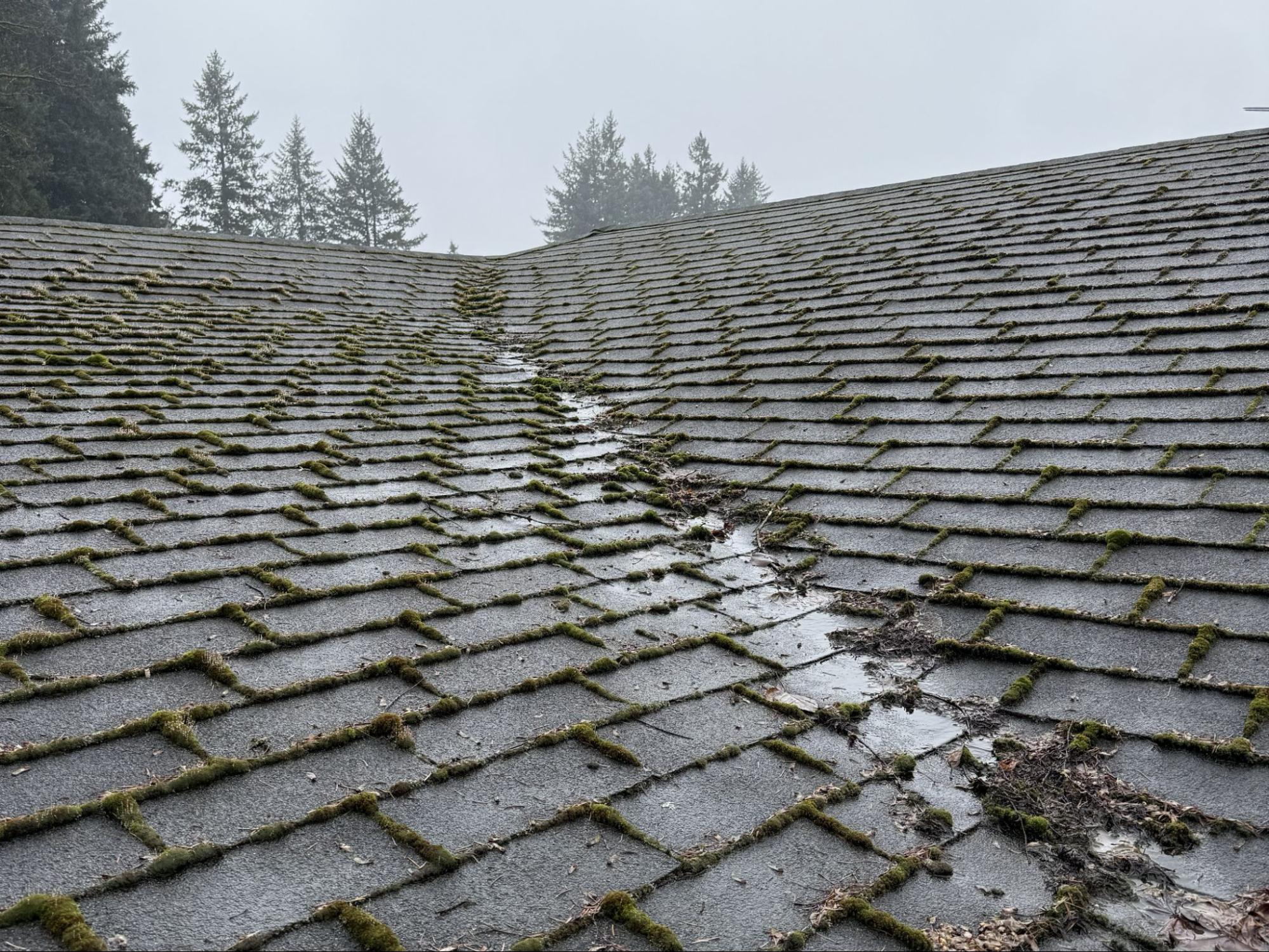
The best time to inspect your roof in Southwest Washington is right after the rainy season ends. Water has had months to find every weak point, and the proof is still sitting up there in the moss, the damp wood, and the stains it left behind.
Wait a few months and that evidence fades: moss dries and shrinks back against the shingles, ceiling stains lighten as the drywall dries, and decking that read wet in May can read dry by September even though the rot underneath has not gone anywhere. The damage does not heal; it just gets harder to find, which is why a professional roof inspection tells you more in early summer than it does in late summer.
These are the signs that show up clearest while the evidence is still fresh:
- Moss on shaded slopes. It holds water against the shingles long after the rest of the roof has dried out.
- Granules in the gutters. Sandy grit means the protective surface is washing off faster than it should.
- Lifted, curling, or cracked shingles. Each one gives water a path underneath, and a wet season widens the gap.
- Stains on ceilings, walls, or attic wood. Water runs along the framing before it drips, so the stain is rarely below where it got in.
Most of that you can spot from the ground or from inside the house. What you cannot see is the condition of the decking, the flashing, and the underlayment, and that is the part that decides your next step. Damage in one section usually calls for a targeted repair, while a roof near the end of its life, leaking in more than one place, or holding moisture in the decking is a replacement.
Why Roof Timing Works Differently in Southwest Washington
Roof timing advice written for the rest of the country does not transfer here, because our wet season is long and our dry window is short. A roof in eastern Washington dries out between storms and spends its winters under cold, mostly dry air. Western Washington is a different climate entirely, wetter and milder because the Cascades separate the two, and roofs from Battle Ground and Washougal north to Kelso and Centralia stay damp for most of the year. The region averages around 42 inches of rain annually, and most of it falls between October and May. That leaves a genuinely dry stretch of about three months, which is the whole reason timing matters here.
What that does to a roof is cumulative. Shaded slopes and heavy tree cover keep sections from ever fully drying, moss takes hold where the surface stays wet longest, and water that slips under a lifted shingle has months to work into the underlayment, the flashing, and eventually the decking. A small problem in a drier climate stays small for years. Here it gets three seasons of steady moisture working on it before anything shows from the ground.
What Happens If You Wait Until the Next Rainy Season
Waiting rarely causes a roof to fail overnight. What it costs you is control. A lifted shingle, a tired flashing joint, or a moss-heavy slope that would have been a straightforward repair in August has eight months of rain working on it by the following spring, and the fix that was available in summer is often off the table by then. Roofs here tend to fail quietly, and the first clear sign is frequently a ceiling stain from water that has been getting in for weeks.
The scope is what changes. A repair turns into a partial replacement once water reaches the underlayment, and a replacement gets more involved once the decking has softened, because that wood has to come off and go back down before any new roofing does. Our guide to winter roof damage in Southwest Washington walks through what a full wet season does underneath the surface. The other thing you lose is the calendar. A project you planned becomes a project you are reacting to, worked around whatever dry days February happens to give you instead of the ones you picked.
Signs a Summer Roof Replacement Is the Right Move
Not every worn roof needs a full tear-off, and Alfred’s Roofing will say so when a repair is the better use of your money. What separates the two is usually not how the roof looks, it is how much of it is involved and how long it has been going on.
These are the signs that point toward replacement rather than repair:
- Your roof is nearing the end of its expected life. Basic 3-tab shingles usually run 15 to 20 years and architectural shingles 25 to 30, and steady moisture here pushes both toward the lower end.
- The same section has been repaired more than once.
- An inspection found soft decking, failed flashing, or moisture underneath the roofing surface.
- Water is getting in at more than one point rather than a single spot.
When two or more of those are true, a summer roof replacement in Southwest Washington usually costs less over the life of the roof than another round of repairs. A roof replacement in Vancouver WA or anywhere else in the region also resets the clock on the whole system, including the underlayment and flashing that repairs leave in place.
Why the Crew Matters as Much as the Calendar
Perfect timing does not save a rushed installation, and this climate finds shortcuts fast. A dry summer week only helps if the crew uses it to do the work properly, which means flashing replaced rather than reused, decking checked before new material goes over it, and someone explaining what they found instead of handing you a number.
Alfred’s Roofing runs licensed and insured crews across Clark County and the surrounding communities, walks homeowners through what the inspection turned up, and provides a free estimate before anything starts.
Roof Replacement Timing FAQs
How long does a roof replacement take in Southwest Washington?
Most residential replacements take one to three days from tear-off to final walkthrough. Larger or more complex roofs run longer, and any decking that needs replacing adds time since that wood comes off and goes back down before new roofing does. Summer scheduling helps because rain is what usually stretches a two-day job into a two-week one.
What happens if it rains during my roof replacement?
Crews plan around the forecast and work in sections, so an exposed area is never left uncovered overnight. If rain moves in mid-project, the open section gets covered and work pauses until conditions clear. This is the main reason summer projects finish faster, since there is far less to work around in July than in October.
Do I need to leave my house during a roof replacement?
No. You can stay home throughout, though it is loud, and the noise carries through the whole house rather than staying above one room. Most homeowners with small children, pets, or work calls plan around the noisiest stretch. Parking gets moved clear of the work area so the crew can stage materials and debris.
Should I replace my roof before it starts leaking?
Ideally, yes. Once water is getting in, it is already reaching the underlayment and often the decking, which turns a roofing job into a repair job for the framing, insulation, and ceilings underneath. A roof inspection is the fastest way to find out whether you have room to plan or need to move now.
Is a summer roof replacement more expensive?
Season alone does not set the price. Cost comes down to the size of the roof, the materials, how difficult the roof is to access, and what condition the decking is in underneath. Booking earlier does give you more room to compare material options and review the estimate without deciding under pressure.
How long does a roof replacement take in Southwest Washington?
Most residential replacements take one to three days from tear-off to final walkthrough. Larger or more complex roofs run longer, and any decking that needs replacing adds time since that wood comes off and goes back down before new roofing does. Summer scheduling helps because rain is what usually stretches a two-day job into a two-week one.
What happens if it rains during my roof replacement?
Crews plan around the forecast and work in sections, so an exposed area is never left uncovered overnight. If rain moves in mid-project, the open section gets covered and work pauses until conditions clear. This is the main reason summer projects finish faster, since there is far less to work around in July than in October.
Do I need to leave my house during a roof replacement?
No. You can stay home throughout, though it is loud, and the noise carries through the whole house rather than staying above one room. Most homeowners with small children, pets, or work calls plan around the noisiest stretch. Parking gets moved clear of the work area so the crew can stage materials and debris.
Should I replace my roof before it starts leaking?
Ideally, yes. Once water is getting in, it is already reaching the underlayment and often the decking, which turns a roofing job into a repair job for the framing, insulation, and ceilings underneath. A roof inspection is the fastest way to find out whether you have room to plan or need to move now.
Is a summer roof replacement more expensive?
Season alone does not set the price. Cost comes down to the size of the roof, the materials, how difficult the roof is to access, and what condition the decking is in underneath. Booking earlier does give you more room to compare material options and review the estimate without deciding under pressure.
Start Planning Your Roof Replacement Before the Next Hard Season
The roofs that cause the least trouble around here are the ones replaced on a schedule somebody chose. Summer gives you that choice: a dry stretch long enough to do the work properly, and enough lead time to understand what your roof actually needs before committing to it. Fall can work too if you start early. By waiting, you not only give up the best timing to replace your roof, but you also leave your home open to possible damage to the property.
If your roof came through the wet season looking worn, an inspection is the honest starting point, and it may tell you a repair is all you need. Either way you will know where you stand before the rain returns. Our team is here when you are ready to schedule an inspection.
