TL;DR
A commercial roof replacement needs a dry deck from tear-off through the final welded seam, and Southwest Washington’s dry stretch typically runs out in early October.
Most property owners are in one of three spots right now: the roof is ready for a full replacement this season, targeted repairs can carry it through to spring, or an inspection is what actually settles the question. Guessing which one applies is usually the most expensive choice.
Most commercial property owners do not think much about the roof until it starts costing them money. A tenant calls about a stain spreading across a ceiling tile. The cooling bill jumps with no clear explanation. Water shows up in a stockroom that has always been dry.
A commercial roof replacement in Southwest Washington depends on the weather far more than residential work does. Flat and low-slope systems need dry, stable conditions from the moment the old membrane comes off to the moment the new seams are welded shut. Once steady rain returns in October, that window closes for months.
Alfred’s Roofing is a licensed and insured contractor handling commercial roofing across Southwest Washington, including TPO systems, traditional flat roofing, and full replacements when that is genuinely the right call.
Why a Commercial Roof Replacement Depends on Dry Weather
A commercial roof replacement is not a bigger version of a residential job. Most commercial buildings in Southwest Washington use low-slope or flat systems such as TPO, EPDM, or built-up roofing, and each of those materials has a narrow tolerance for moisture during installation. Tear-off exposes the bare deck, sometimes for hours at a time, and a soaked deck cannot simply be covered back up and left for the next dry day.
Three parts of the process depend on a dry surface, and each one fails in its own way when it gets wet:
- The deck. Insulation and membrane go down directly over it, so any moisture underneath gets sealed in. Trapped water rots wood, corrodes metal, and quietly destroys insulation value long before anyone notices a problem from inside the building.
- The adhesives. The products that bond insulation and membrane in place need a dry surface to grip. Applied over damp material, they can hold at first and release later, usually once winter weather is already here.
- The welded seams. TPO seams are joined with hot air, using heat and pressure to fuse two sheets into one. Moisture caught in that seam weakens the bond immediately, and it rarely shows up until months later as a leak nobody can trace.
None of these problems announce themselves on install day. They show up in year two or year three, which is why the weather window matters as much as the material you choose.
Our team at Alfred’s Roofing watches the forecast as closely as we watch the schedule. A stretch of dry, mild weather lets us move through tear-off, decking repairs, insulation, and membrane installation without stopping to tarp an open roof overnight. Once steady rain sets in, that same job gets broken into stages, and a project that would have run a few days can stretch into weeks.
What Happens if You Miss the Dry Window?
Southwest Washington’s dry season is short, and once it closes in October, most full replacements on flat and low-slope roofs get scheduled for the following year. A planned commercial roof replacement typically waits for late spring or early summer, when the deck can stay dry long enough to finish the job in one stretch. That is not an absolute rule. A roof that is actively leaking or structurally unsound gets addressed regardless of the season, because the damage compounds faster than the weather cooperates.
Waiting does not mean the building sits unprotected through the winter. Targeted repairs, including resealing seams, patching damaged membrane, and clearing blocked drains, can carry a sound roof through the wet months. Our team handles this kind of commercial roofing work year-round, and for a lot of buildings it is the practical move rather than rushing a full replacement into a closing weather window.
The tradeoff is worth naming plainly. Repairs are a bridge, not a fix, and the replacement still needs a real number in next year’s budget. The approach that tends to backfire is doing nothing at all and hoping the roof holds until summer, especially when nobody has checked whether it actually can.
Repair, Replace, or Inspect: Which Path Fits Your Building?
Almost every property owner with an aging commercial roof is choosing between three paths right now, and the right one depends on the condition of the roof rather than the calendar. Here is how the three compare.
| What you’re seeing on the roof | What it usually means | Reasonable next step |
|---|---|---|
| The roof is past its expected service life, or several problems are showing up at once | The building is a strong candidate for a full commercial roof replacement while dry weather is still available | Schedule an inspection now to confirm the scope and hold a spot in the remaining dry-weather window |
| Problems are isolated, such as one separated seam, ponding in a single low spot, or a small area of damaged membrane | Targeted repairs can likely carry the roof through the wet season | Repair this fall, then budget the full replacement for late spring |
| The roof’s condition is unclear, or the building has never had a professional evaluation | There is not enough information yet to choose a direction | Get a commercial roof inspection before assuming either direction |
None of these paths is better than the others on its own. A building that genuinely only needs repairs gains nothing from an unnecessary replacement, and a building with a failing deck gains nothing from another season of patchwork. The professional roof inspection is what tells you which row your building actually belongs in.
Signs a Commercial Roof Needs Replacing Rather Than Another Repair
A handful of signs tend to separate a roof that can wait from one that cannot, and most of them turn up during a routine walk-through or from inside the building.
On the roof itself, watch how water behaves. Ponding that lingers more than 48 hours after rain is the clearest signal that drainage is no longer working the way it was designed to, and standing water adds weight the structure was never built to carry for months at a time. Lifted or separated seams matter for a different reason. A single failed seam is a repair. Seams giving way in more than one area usually means the membrane has aged past the point where patching keeps up, and winter moisture works into those openings a little further with every freeze and thaw.
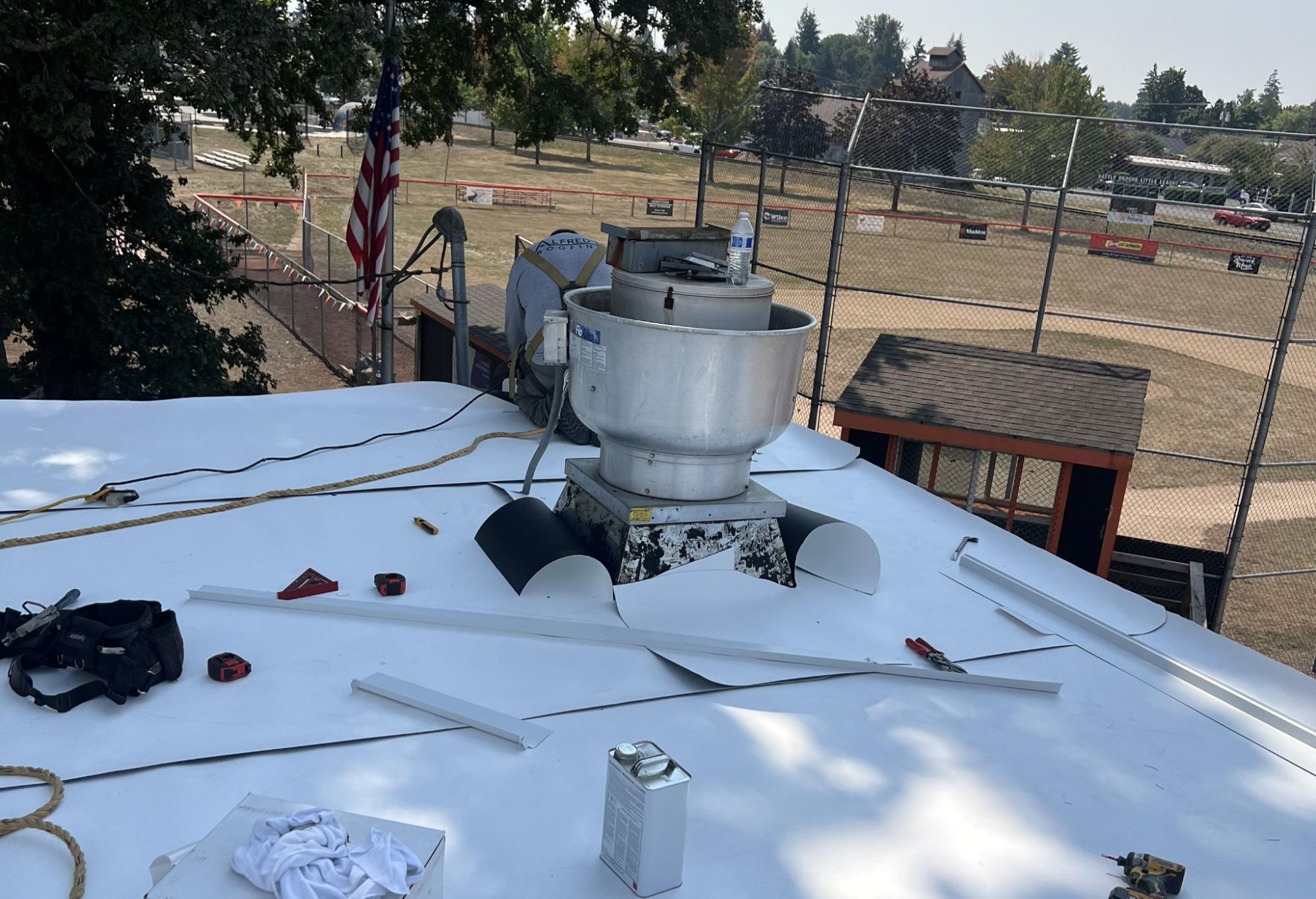
Interior signs deserve just as much attention, partly because anyone can spot them without setting foot on the roof. Staining that spreads across ceiling tiles, a musty smell in a storage room that never used to have one, or heating and cooling bills climbing without a matching change in usage all point the same direction. Each one suggests moisture has already reached the insulation layer, and wet insulation does not dry out on its own. It keeps losing R-value until it comes off with the rest of the system.
Age ties the rest together. A roof at or past its expected service life showing any of the signs above is usually telling you the repair cycle has run its course, while the same signs on a roof only ten years old are worth investigating before assuming the worst.
Reflective Roofing Options and Whether They Pay Off Here
If a full commercial roof replacement is on the table, the surface is worth deciding on deliberately rather than defaulting to whatever was up there before. Reflective, or “cool,” roofing is built to bounce sunlight away instead of absorbing it, which keeps the roof surface and the space beneath it cooler through the summer.
The difference is significant at the surface. Energy Star notes that a clean white roof reflecting about 80 percent of sunlight stays roughly 50 degrees cooler on a summer afternoon than a gray roof reflecting only 20 percent, because cool roofing surfaces reflect sunlight rather than holding onto it.
How much that shows up on your utility bill is a separate question, and the honest answer depends on the building. Cooling costs are a smaller share of the year here than in hotter parts of the country, so a warehouse with minimal air conditioning will see less benefit than a building running significant cooling loads through the summer. There is a small tradeoff in the other direction too, since a reflective roof gives up a bit of passive warmth in winter. For most buildings in this region the summer savings still come out ahead, but it is not the dramatic swing the marketing sometimes suggests.
The more practical reason reflective surfaces matter here is heat and UV exposure over time. A membrane running cooler through summer ages more slowly, which is part of why TPO roofing is a common choice for flat and low-slope commercial buildings in Southwest Washington, alongside its welded-seam durability. Other buildings are better served by traditional flat roofing depending on drainage, insulation, and the existing structure. Our team can walk through which system fits your building rather than installing whatever was there last.
Commercial Roof Replacement Questions Property Owners Often Ask
How long does a commercial roof replacement typically take?
How long does a commercial roof last?
Can a commercial roof be replaced during the fall?
Is it safe to wait until spring if my roof is only showing minor issues?
What is the difference between repairing and replacing a commercial roof?
Does a new commercial roof affect energy costs?
How long does a commercial roof replacement typically take?
The timeline depends on roof size, how many layers come off, and whether the decking needs repair. A straightforward flat roof on a small to mid-sized building often runs a few days to about a week. Larger or more complex buildings can take two to four weeks, and hidden deck damage extends that.
How long does a commercial roof last?
Most commercial roofing systems last 15 to 30 years, though the range shifts by material. EPDM and TPO membranes commonly reach 20 to 30 years, built-up roofing runs 15 to 30 depending on maintenance, and modified bitumen typically lasts 15 to 20. Drainage, rooftop foot traffic, and installation quality all affect where a specific roof lands.
Can a commercial roof be replaced during the fall?
Sometimes, if the weather stays dry and mild long enough to finish without interruption. The risk is that fall conditions here turn quickly, and a project started too late gets completed in stages instead of straight through. Staged work is not a failure, but it takes longer and costs more to protect between phases.
Is it safe to wait until spring if my roof is only showing minor issues?
It can be, as long as the repairs done beforehand are thorough rather than cosmetic. That usually means resealing every compromised seam, clearing all drains and scuppers, and confirming no moisture has reached the insulation. A quick patch over one visible spot is what tends to fail partway through winter.
What is the difference between repairing and replacing a commercial roof?
Repairs address specific problem areas, such as a failed seam or a damaged section of membrane. A replacement removes the system down to the deck and installs new insulation and membrane throughout. Which one a building needs comes down to whether the problems are isolated or spread across the roof, and a professional evaluation settles that.
Does a new commercial roof affect energy costs?
It can, mainly through improved insulation rather than the membrane itself. Older roofs often have insulation that has absorbed moisture and lost much of its value, so replacing it restores performance that was quietly lost years ago. Reflective surfaces add some summer benefit on buildings with real cooling loads.
Deciding Before the Weather Decides for You
The property owners who come out ahead this time of year are not the ones who move fastest. They are the ones who find out what their roof actually needs while replacing it is still an option, rather than deciding from the ground based on a guess about how much winter a tired membrane has left. A roof that needs replacing does not get easier to replace in November, and a roof that only needs repairs should not be torn off to settle a question an inspection could have answered.
Alfred’s Roofing has handled commercial roofing across Southwest Washington for three decades, including TPO systems, traditional flat roofing, and full replacements when that is genuinely the right call. If you are not sure which direction your building is headed, reach out to our team and we will schedule an inspection and give you a straight answer either way.
