

Single-Ply Roofing Built for Vancouver’s Wet Season
When a flat or low-slope roof over a Vancouver storefront or warehouse wears out, the first real question is which membrane can handle our rain. Water sits on a low-slope roof instead of running off, so our long wet season tests every seam for months at a time.
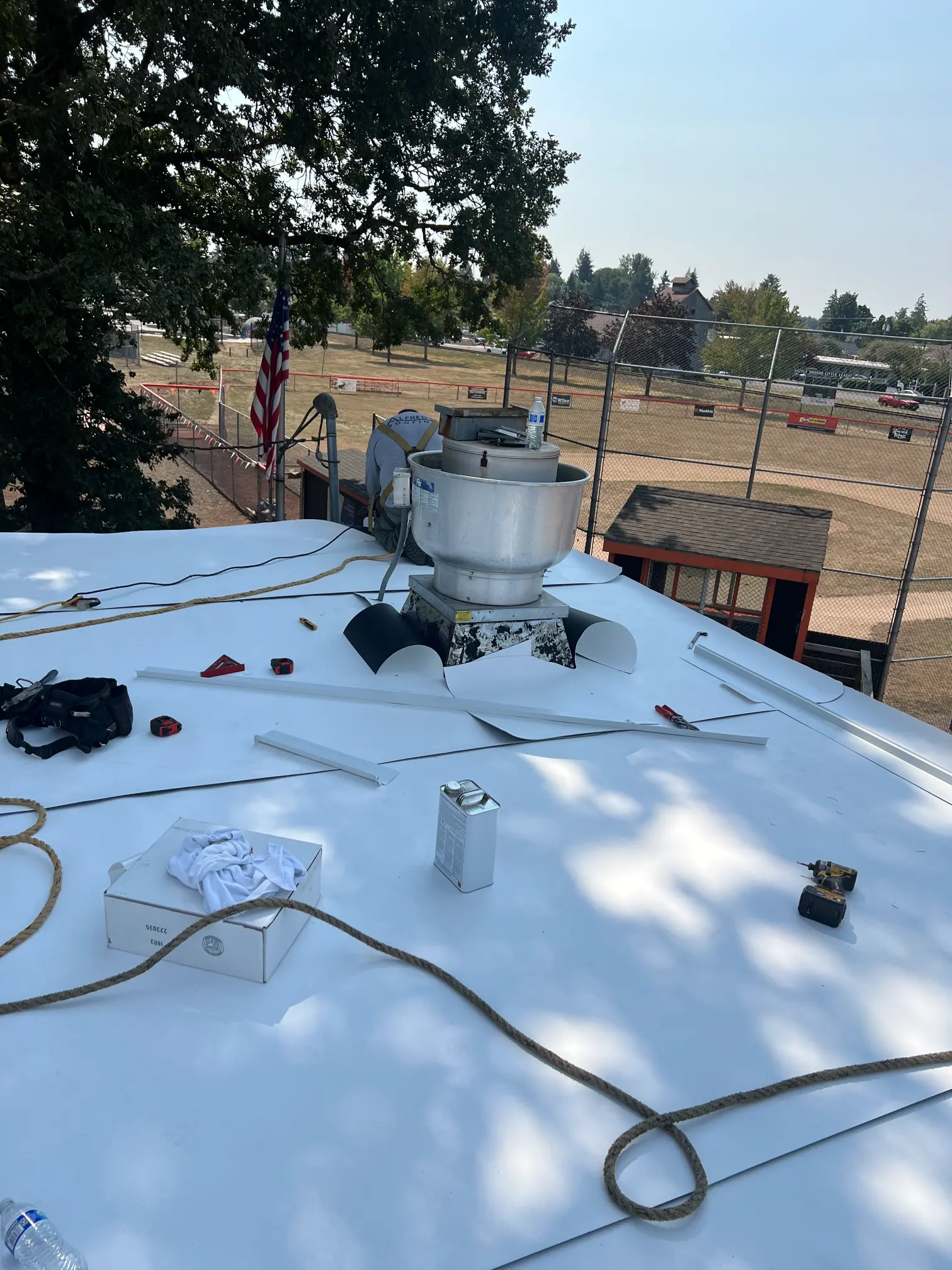
TPO roofing has become one of the most common choices for commercial and low-slope buildings across Clark County, and the reasons hold up in our climate. The seams are heat-welded into one continuous, watertight surface, which leaves far fewer weak points for water to find during weeks of steady rain. The light, reflective membrane sheds our summer sun without trapping heat against the space below. Alfred’s Roofing installs TPO systems throughout Vancouver, from the retail corridors along Fourth Plain Boulevard and Highway 99 to the light industrial properties near Fruit Valley. On a flat roof, the quality of the installation is what keeps water out season after season, so that is where we put our attention.
Not Sure TPO Is the Right Fit for Your Building?
Our team can walk your roof, talk through whether TPO makes sense for it, and give you a straight estimate with no pressure.
TPO Roofing, Explained in Plain Terms
TPO stands for thermoplastic polyolefin, though most owners just know it as the white membrane they see on flat commercial roofs around town. What makes it work here comes down to the seams. Instead of gluing or taping the sheets, we weld them together with heat so they fuse into a single piece, and a fused seam is one less spot for a Northwest winter to work its way through. The pale surface earns its keep in the other season too, bouncing off the summer sun rather than baking the space below. A single-ply TPO membrane runs thicker than people expect, and when it drains well and gets a look now and then, we regularly see 20 to 25 years out of one. It fits the buildings it usually sits on, warehouses, storefronts, offices, and the odd low-slope stretch over a home addition. Next to the old tar-and-gravel roofs it tends to replace, it is lighter, cleaner, and a good deal easier to trust once the rain sets in.
What We Handle on a TPO Roof
Most TPO work falls into a handful of jobs, whether you are putting a membrane on a new building or nursing an older one through another winter. Here is what we take on for commercial and low-slope properties around Vancouver.
- New TPO Installation: We lay down fresh TPO membrane on new construction and low-slope additions, welding the seams tight so the roof is ready before the rain returns.
- TPO Roof Replacement: When an old membrane or a tired tar-and-gravel roof has run its course, we tear it off, sort out the insulation and drainage underneath, and set a new TPO system on a clean base.
- TPO Roof Repair: Leaks on a low-slope roof usually trace back to a lifted seam, a tired flashing, or a spot around a rooftop unit, and we track down the real source before it soaks the insulation below.
- Seam and Flashing Work: The seams and the edges take the most abuse in our climate, so we re-weld separations and rebuild flashing around drains, vents, and HVAC curbs where water tends to sneak in.
- Reflective Membrane Upgrades: TPO’s light surface bounces off the summer sun, and for owners watching cooling costs, that reflective membrane is a quiet upgrade over an older dark roof.
- Low-Slope Residential TPO: Plenty of homes carry a flat section over an addition, porch, or garage, and TPO gives those low-slope stretches the same watertight coverage we put on commercial buildings.
Whether the job is a full commercial TPO roofing project or a single stubborn leak, the goal is the same: a membrane that drains clean and stays sealed through the wet months. These sit within the wider commercial roofing work we do across Vancouver, so if your building needs more than the roof membrane alone, we can look at the whole picture.
Ready to Talk Through Your TPO Roof?
How TPO Compares to EPDM and PVC
TPO, EPDM, and PVC are the three single-ply membranes you weigh most on a low-slope building. Here is the short version of how they stack up.
- TPO: Heat-welded seams fuse into one watertight sheet, and the light surface reflects summer sun instead of holding heat. It covers a large roof at a reasonable cost, which is why it fits so many Clark County buildings.
- EPDM: The original black rubber membrane. Durable and easy to repair, but the dark surface soaks up heat, and its seams are taped or glued rather than welded.
- PVC: TPO’s close cousin, also heat-welded and light-colored. It handles grease and chemicals better, which suits a restaurant exhaust, though it usually costs more.
No membrane is the best one in the abstract. The right pick depends on your building, your budget, and how the roof gets used, the same call we help owners make on any flat roofing project. Tell us what you are working with and you will get a straight answer, not a pitch for the highest-margin option.
Why Vancouver Property Owners Trust Alfred’s for TPO
For more than thirty years, Alfred’s Roofing has installed and repaired low-slope roofs across Southwest Washington, and that experience shows up in the parts of a TPO roof that keep water out: clean welds, solid flashing, and drainage that actually moves water off the roof. We are a licensed and insured contractor, we keep organized job sites, and the work goes to trained crews rather than whoever happens to be free that week.
That level of installation is recognized through our IKO Craftsman and GAF Master Elite certifications, a bar manufacturers only extend to contractors they trust. For you, it means a TPO roof set up to last the full 20 to 25 years it should.
What Clark County Owners Are Saying
⭐⭐⭐⭐⭐
“The entire crew was extremely professional, hard-working, and knowledgeable. The job was completed on time.”
Renee W., Verified Customer
⭐⭐⭐⭐⭐
“They are friendly, efficient, and respectful. The crew was fast, clean, and polite. Highly recommended!”
Ean G., Verified Customer
Get Your TPO Project on the Calendar
TPO Work Across Vancouver and Clark County
Most of our TPO jobs sit along Vancouver’s commercial stretches, the storefronts and offices near Fourth Plain Boulevard and Highway 99, and the warehouses and light industrial buildings around Fruit Valley. These are the low-slope roofs that take the brunt of our wet season, and they are where a welded membrane earns its keep.
Beyond those corridors, we handle low-slope roofs throughout Vancouver and the surrounding towns, including Battle Ground, Ridgefield, Camas, Washougal, and Woodland. If your building sits somewhere in Southwest Washington and carries a flat or low-slope roof, we can get to it.
Can I put a TPO roof on my house?
Is TPO worth it in our cloudy, wet climate?
How long does a TPO roof last?
How much does a TPO roof cost?
Vancouver TPO Roofing FAQs
Can I put a TPO roof on my house?
Yes, as long as your home has a flat or low-slope section, like the roof over an addition, porch, or garage. TPO gives those low-pitch areas the same sealed, watertight surface it gives a commercial building, which is something standard shingles cannot do on a near-flat slope.
Is TPO worth it in our cloudy, wet climate?
Mostly yes, though not for the reason it gets sold on elsewhere. TPO’s reflective surface saves less on cooling here than it would in a hot, sunny state, since our summers are short. What actually earns its keep in Southwest Washington is the welded seams. Through months of steady rain, one continuous sheet holds up far better than taped or glued joints.
How long does a TPO roof last?
A well-installed TPO roof commonly lasts 20 to 25 years. Drainage is the deciding factor, since water that sits on the membrane for days will cut that short.
How much does a TPO roof cost?
It depends on a few things: the size of the roof, the condition of the layers underneath, how much rooftop equipment has to be worked around, and the membrane thickness you go with. A large, straightforward roof costs less per square foot than a small one broken up by vents and units. The only figure worth trusting is one that comes from an on-site look, so we give you that in a written estimate before any work starts.
Start With a Straight Answer About Your Roof
Before you commit to anything, get a clear read on what your building actually needs. Our team will walk the roof, tell you honestly whether TPO is the right fit, and hand you a written estimate with no pressure to move. Book your free roof assessment and we will take it from there.
