

TL;DR
October brings Southwest Washington’s first steady rain right as the leaves start to fall, so clogged gutters and small weak spots on your roof get tested all at once.
A six-point fall roof maintenance routine covers gutters, downspouts, overhanging limbs, pipe boots and flashing, attic airflow, and a professional inspection.
Starting it this month leaves time to fix anything you find before the wettest stretch of the year.
For a lot of Southwest Washington homeowners, the first real October storm is when small roof problems finally show themselves. A gutter packed with leaves spills over at the corner, a downspout backs up, or a dried-out seal around a vent lets water slip through. None of these problems start in October, but this is usually the month they come to light.
This fall roof maintenance checklist covers six tasks in the order that makes the most sense. Some take an afternoon with a ladder or a garden hose, and others are best left to a professional. Alfred’s Roofing has served homeowners across Southwest Washington since 1994, and the last step on the list is a free inspection from our team.
Why October Is the Deadline for Fall Roof Maintenance
In Vancouver, October averages 13.6 rainy days and 3.61 inches of rain, according to NOAA’s 1991 to 2020 climate normals for the area. Compare that to July, which averages fewer than four rainy days all month. The wettest stretch comes next, with November, December, and January each averaging about 19 to 20 days of rain and more than 6 inches per month.
Once the rain sets in, every clog and small crack gets tested again and again. Most roof repairs also need dry weather, and dry days get harder to find as the season goes on.
The age of local homes plays a part as well. About 1 in 5 homes in Clark County was built in the 1990s, according to U.S. Census Bureau estimates, and the typical home in the county dates to 1993. That puts many local roofs at an age where they have either been replaced once already or are getting close. When months of steady rain arrive, an older roof has less room for error.
The 6-Point Fall Roof Maintenance Checklist
Work through these steps in order. The first three deal with water and wind from the outside, the next two look for hidden weak spots, and the last one brings in a professional.
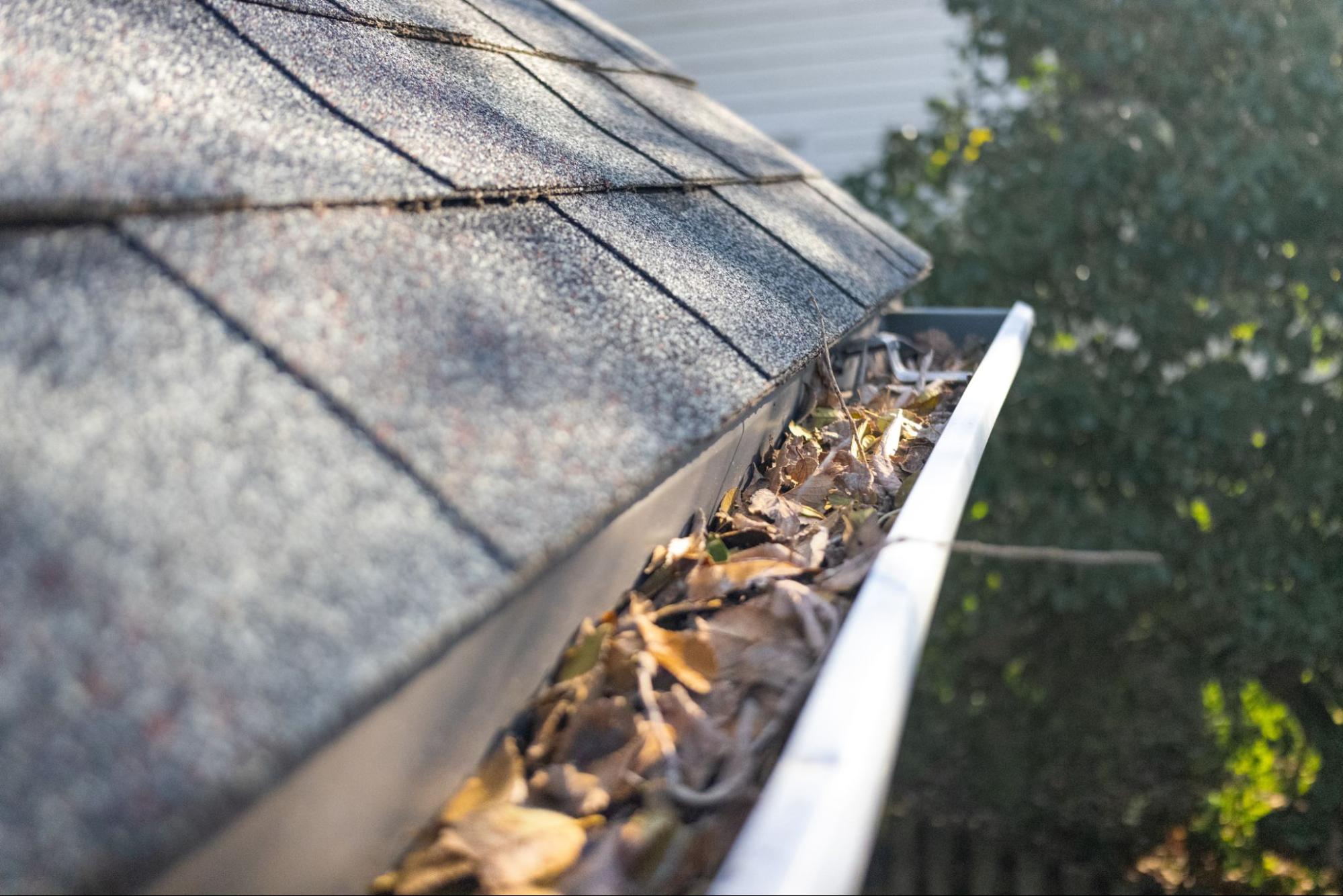
1. Clear Your Gutters Once Most Leaves Are Down
Cleaning gutters too early often means doing the job twice. Bigleaf maples and Oregon white oaks, two native trees you will see across Clark County, can keep dropping leaves through October and into November, depending on the year. For best results, clean your gutters once most of the leaves near your home have fallen. If your trees hang on to their leaves longer, plan a quick second pass before the heaviest rain arrives.
Scoop out leaves, needles, and sludge by hand or with a gutter scoop. Set your ladder on flat, solid ground and have someone keep it steady. Stay off the roof itself, especially once it is damp. If you would rather stay off the ladder, Alfred’s Roofing offers gutter cleaning in Vancouver, WA, and the surrounding towns. Book it for a dry day once most of the leaves are down.
2. Test Your Downspouts and Check Where the Water Lands
Clean gutters only help if the water has a clear way out. Run a garden hose into each gutter near the top of a downspout. Within a few seconds, water should pour out the bottom in a steady stream. If you hear a trickle or a gurgling sound, or see water backing up at the top, that usually points to a clog inside the pipe. Most clogs clear with a hose pushed up from the bottom or a plumber’s snake. If a gutter sags, leaks at the seams, or pulls away from the house while you test it, the system may be due for a new gutter installation rather than another cleaning.
Next, look at where that water ends up. It should exit onto a splash block or extension that carries it several feet from the house. Water that pools against the foundation can seep into crawl spaces and basements over a long wet season.
3. Trim Back Branches Before Windstorm Season
Windstorms in the Pacific Northwest happen most often in December, but October can bring strong storms too. The Columbus Day Storm of October 12, 1962, is still the region’s best-known example, with gusts topping 100 mph in the Portland area.
Branches over your roof cause trouble in two ways. During a storm, they can snap off and crack or puncture shingles. On calm days, they rub against the roof surface and drop debris into the gutters you just cleaned. A good rule of thumb is to keep limbs at least 10 feet away from your roof. Trim small branches you can reach from the ground with a pole saw. For anything large or high up, call a professional tree service, and contact your utility company about any limbs near power lines.
4. Look Over Pipe Boots and Vents for Summer Sun Damage
Summer brings little rain, but long sunny days are hard on rubber and sealant. Pipe boots are the rubber collars that seal around the plumbing vent pipes on your roof. Over time, sun exposure can dry them out until they crack or pull away from the pipe. Once that happens, rain can run down the pipe and into the attic.
You can check them from the ground with a pair of binoculars. Look for rubber that appears split, shrunken, or separated from the pipe, and for roof vents with cracked or missing sealant around the base. While you have the binoculars out, scan the metal flashing around your chimney and any skylights for gaps, rust, or loose edges. If you spot a problem, leave the fix to a roof repair professional, since these spots sit right on the roof surface.
5. Get Your Attic Ready for Heating Season
Once the heat comes on, your home creates a different kind of moisture problem. Warm, damp air from showers, cooking, and laundry rises into the attic. If it has no way out, it condenses on the cold underside of the roof deck.
On a dry afternoon, take a flashlight into the attic and check two things. Follow the bathroom and kitchen fan ducts first. Each one should run all the way to a vent cap on the roof or an outside wall, because a duct that ends in the attic blows damp air straight onto the wood. Then make sure insulation sits clear of the soffit vents, the openings under the eaves that let fresh air in. A loose duct is usually a simple fix, but if the space still feels clammy, have a roofer review the overall vent setup.
6. Book a Free 20-Point Inspection While Dry Days Remain
The first five steps cover what a homeowner can safely see, and our summer roof maintenance guide walks through spotting shingle wear from the ground. The rest of the roof, including the shingle surface up close, the flashing, and any soft spots in the decking underneath, needs a trained roofer.
Alfred’s Roofing offers a free 20-point inspection for homeowners across Southwest Washington. Our licensed and insured crew walks the roof and gives you a clear summary of what needs attention now and what can wait. Book a roof inspection in Vancouver, WA, or anywhere in our service area, and you will still have time to act on the results before the heaviest rain arrives.
Here is the full checklist at a glance, with the best timing for each task and who usually handles it.
| Checklist Item | Best Timing | Who Handles It |
|---|---|---|
| Clear gutters | Once most leaves have fallen, often late October into November | Homeowner or Alfred’s Roofing |
| Test downspouts | Same day as gutter cleaning | Homeowner |
| Trim branches | Early October, before storms pick up | Homeowner for small limbs; tree service for large or high limbs |
| Check pipe boots and vents | Any dry day | Homeowner spots it; roofer repairs it |
| Prep the attic | Before the heat comes on | Homeowner; roofer if moisture lingers |
| Free 20-point inspection | October, while dry days remain | Alfred’s Roofing |
Most homeowners can finish the first five items over a weekend or two, which leaves the inspection to cover everything else.
Fall Roof Maintenance FAQs for Southwest Washington Homes
How often should gutters be cleaned in Southwest Washington?
Do gutter guards mean I never have to clean my gutters?
What should I do if my roof starts leaking during a storm?
Is fall a good time to treat moss on my roof?
How often should gutters be cleaned in Southwest Washington?
Most Southwest Washington homes need their gutters cleaned at least twice a year, once in late fall and once in spring. Homes under Douglas firs or other evergreens often need three or four cleanings, since those trees drop needles year-round. If your gutters spill over during an ordinary rain, they need attention sooner. Alfred’s Roofing offers gutter cleaning if you would rather not do it yourself.
Do gutter guards mean I never have to clean my gutters?
Gutter guards cut down on how often you clean, but they do not remove the chore. Fir needles and fine debris can still pile up on top of many guard styles or slip through them, so guarded gutters still need a check and rinse at least once a year. If water spills over your guards during a normal rain, a professional cleaning can clear out what they have trapped.
What should I do if my roof starts leaking during a storm?
Start by protecting your belongings. Move furniture and electronics away from the drip, set out a bucket, and take photos of the damage for your records. Stay off the roof while it is wet or windy. Once you are safe, call Alfred’s Roofing at (360) 504-4685. Our team can trace the source and schedule a roof repair as soon as conditions allow.
Is fall a good time to treat moss on my roof?
Yes. Moss grows most actively in cool, wet weather, and Oregon State University suggests treating roofs just before the fall rains or in early spring. Most treatments keep moss in check for up to about a year, though it returns faster on shady roofs. Follow the label closely and keep runoff away from garden beds. Since this means getting on the roof, many homeowners hire a professional.
Start the Rainy Season a Step Ahead
October rewards homeowners who act before the rain does. Each task on this list is small, but together they give water a clear path off your roof and away from your home. They also bring weak spots to light while a fix is still simple.
When you are ready for the part that needs a professional assessment, reach out to our team or call (360) 504-4685 to set up your free 20-point inspection. We are happy to answer your roofing questions and help you plan for the months ahead.
